


 
|
|


Feature Article
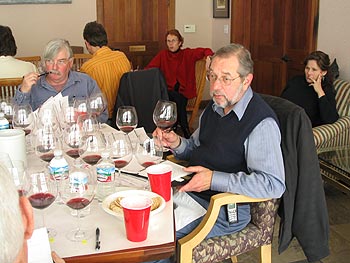
Dan Berger’s panel of Los Carneros winemakers struggle to put their finger on what exactly makes the region's Pinot Noirs distinctive.
Los Carneros Pinot Noir: a regional signature becomes illegible as winemakers seek a new identity
Over time, wine makers in Carneros began to sense that they had to work diligently to get higher scores through elimination of the distinctive terroir components that had marked their wines of the past.
by
Dan Berger
February 12, 2006
Investigating a grape variety’s ability to display its unique regional character is, in one way, an exercise in pure faith. We make the assumption that such a character really does exist. After all, we muse, the concept of terroir has been around for a long time, a virtual icon in French vinoculture with translated versions from other languages (Spanish, Italian, German), and the formal recognition of the U.S. government, the American Viticultural Appellation.
So leaping head first into the question of an appellation signature, which we assume to be present in a wine as famous as Carneros Pinot Noir, shouldn’t be a chore. We simply sit down with the experts -- those who make the wines -- and we listen and take careful notes on their observations on the characteristics of their current wines and how they reflect the same characteristics from past vintages. And we try the wines with them, and we try to spot the threads that nature weaves into a specific, identifiable set of traits. And that defines the terroir and thus the signature of the appellation.
Good luck.
When we did this recently, with a room filled with five formal judges and numerous equally skilled onlookers, the conclusions reached were hazy at best, and confusing at worst. For starters, what we once witnessed as a distinctive regional component, a faint hint of green tea or beet tops (well, faintly green anyhow), was all but gone.
Where had it gone? we asked. And what had replaced it? we wondered.
The bottom line, which was voiced most assertively by Mike Richmond of Bouchaine Vineyards (which hosted this first Carneros event for AppellationAmerica), was that things are in a state of flux for this unique and large region whose expanse traverses over the Napa-Sonoma county line, and which has slightly cooler and slightly warmer sub-regions, adding to the difficulty of typing it.
The element we once found so prevalent in Carneros Pinot Noir, that fascinating “forest floor after a rain” note of dried herbs, brush, and an almost minty note at times, was a function not only of the region, said Richmond, but also of earlier trellising systems, clones, and wine making techniques.
And he added, stating the obvious, “a lot has changed in the last 15 years.”
Indeed, things have changed, and one of the most major of them occurred nearly 20 years ago. The phylloxera infestation that ravaged vines in California’s North Coast in the mid- to late 1980s forced replanting of vineyards just as some new, fast-ripening, cold-climate-developed Pinot clones were coming out of quarantine. The result was that most of the vineyards that were replanted here had some if not a lot of the new so-called Dijon clones, which most wine makers saw as a solution to their color problem.
A bit of background: Almost all California Pinot Noir, left to its own devices 20 years ago, would make a lovely if pale-colored wine. Some wine makers back then took to adding a touch of a black grape variety to darken the wine. Petite Sirah or Alicante Bouschet were the wine makers’ best friends in this regard. Though even smaller amounts of these could harm the delicate aroma of the Pinot.
The Dijon clones solved this problem. They had darker colors than the old “Martini clone” and “darker” flavors as well. This was a characteristic that was most loved by some of the nation’s number-scoring wine critics, who seem to dote on wines that are “rich” and “powerful” and “concentrated.” As if those characteristics are devoutly to be wished regardless of which varietal is being evaluated.
The Dijon clones came along just as Pinot Noir was being roundly criticized for lacking depth. Never mind that the basic essence of great Pinot Noir is its silkiness and its feminine charms. The reviewers liked all red wines big, and the Dijon clones delivered that.
So with the replanting of the phylloxerated vines came a new harvest dynamic. No longer did the wine maker fear making a pale-colored wine. No longer was there the widespread concern that late harvesting would produce an over-ripe character that was atypical of the variety, because the new clones provided for a “narrower” and denser, more compact wine.
The Carneros wines of the past were, in fact, a slightly divergent group because of one other factor that locals knew but declined to speak about openly: the truly diverse conditions that various sub-regions of the area offered. On one property alone, farmed by Angelo Sangiacomo, some of the Pinot Noir came out more herbal than on other portions of the same Sonoma County ranch.
Then there is the Napa side, some areas of which were decidedly warmer than others to the south. For just one extreme example, look at the Congress Valley sub-region of Carneros, which cuts diagonally northeastward, split by the Old Sonoma Road, where Tony and JoAnn Truchard long ago planted Cabernet Sauvignon, and from which vineyard Francis Mahoney once made (1977) an absolutely fabulous and classic Napa Valley Cabernet. Today this same ranch easily ripens warm-loving Syrah as well.
Sub-regional and clonal differences clearly made for a shifting style dynamic for Pinot Noir in the Carneros. However, one additional factor (those dad-blamed scores!) put further demands on wine makers: they had to make wines that were immediately impressive and completely lacking any of the methoxypyrizine (herbal notes) that had always been a part of Carneros Pinot Noir’s makeup!
One way to do that was by pushing harvest dates later and later, pushing the grapevine to hold onto its grapes beyond the point where any of the pyrazine-y notes remained. The grapes then verged on over-ripeness, with desiccation playing the major role in the “plum” and near-raisin-y components taking over to blot out the green.
At this point, it was clear, the regional character of the wine was being compromised.
Scoring “systems” for wine, by their very nature, have no latitude in them and cannot accept as a positive element the notion of regional character. But such “systems” can easily use “regional characteristics” in defense of the homogeneity that is so essential for some reviewers. This regional character is seen as antithetical to “great” wine, allowing a reviewer to lower his or her score.
Wine makers in Carneros began to notice a pattern: when they had classic Carneros characteristics in an otherwise terrific wine, often it would not get as high a score as another wine (or wines) that, when they were sampled by the wine makers, could be seen as having none of the faint traces of pyrazine -- that very element that defines Pinot Noir in some regions and which makes it so classic when the wines are aged for just a few years.
Over time, wine makers in Carneros began to sense that they had to work diligently to get higher scores through elimination of the distinctive terroir components that had marked their wines of the past. Since the Dijon clones (notably those identified as 667 and 777) provided this mechanism, they were naturally one element of the new “formula.” But therein came a problem.
As cold-hardy clones, these selections had been developed for a truly cold climate since t
So leaping head first into the question of an appellation signature, which we assume to be present in a wine as famous as Carneros Pinot Noir, shouldn’t be a chore. We simply sit down with the experts -- those who make the wines -- and we listen and take careful notes on their observations on the characteristics of their current wines and how they reflect the same characteristics from past vintages. And we try the wines with them, and we try to spot the threads that nature weaves into a specific, identifiable set of traits. And that defines the terroir and thus the signature of the appellation.
Good luck.
When we did this recently, with a room filled with five formal judges and numerous equally skilled onlookers, the conclusions reached were hazy at best, and confusing at worst. For starters, what we once witnessed as a distinctive regional component, a faint hint of green tea or beet tops (well, faintly green anyhow), was all but gone.
Where had it gone? we asked. And what had replaced it? we wondered.
The bottom line, which was voiced most assertively by Mike Richmond of Bouchaine Vineyards (which hosted this first Carneros event for AppellationAmerica), was that things are in a state of flux for this unique and large region whose expanse traverses over the Napa-Sonoma county line, and which has slightly cooler and slightly warmer sub-regions, adding to the difficulty of typing it.
The element we once found so prevalent in Carneros Pinot Noir, that fascinating “forest floor after a rain” note of dried herbs, brush, and an almost minty note at times, was a function not only of the region, said Richmond, but also of earlier trellising systems, clones, and wine making techniques.
And he added, stating the obvious, “a lot has changed in the last 15 years.”
Indeed, things have changed, and one of the most major of them occurred nearly 20 years ago. The phylloxera infestation that ravaged vines in California’s North Coast in the mid- to late 1980s forced replanting of vineyards just as some new, fast-ripening, cold-climate-developed Pinot clones were coming out of quarantine. The result was that most of the vineyards that were replanted here had some if not a lot of the new so-called Dijon clones, which most wine makers saw as a solution to their color problem.
A bit of background: Almost all California Pinot Noir, left to its own devices 20 years ago, would make a lovely if pale-colored wine. Some wine makers back then took to adding a touch of a black grape variety to darken the wine. Petite Sirah or Alicante Bouschet were the wine makers’ best friends in this regard. Though even smaller amounts of these could harm the delicate aroma of the Pinot.
The Dijon clones solved this problem. They had darker colors than the old “Martini clone” and “darker” flavors as well. This was a characteristic that was most loved by some of the nation’s number-scoring wine critics, who seem to dote on wines that are “rich” and “powerful” and “concentrated.” As if those characteristics are devoutly to be wished regardless of which varietal is being evaluated.
The Dijon clones came along just as Pinot Noir was being roundly criticized for lacking depth. Never mind that the basic essence of great Pinot Noir is its silkiness and its feminine charms. The reviewers liked all red wines big, and the Dijon clones delivered that.
So with the replanting of the phylloxerated vines came a new harvest dynamic. No longer did the wine maker fear making a pale-colored wine. No longer was there the widespread concern that late harvesting would produce an over-ripe character that was atypical of the variety, because the new clones provided for a “narrower” and denser, more compact wine.
The Carneros wines of the past were, in fact, a slightly divergent group because of one other factor that locals knew but declined to speak about openly: the truly diverse conditions that various sub-regions of the area offered. On one property alone, farmed by Angelo Sangiacomo, some of the Pinot Noir came out more herbal than on other portions of the same Sonoma County ranch.
Then there is the Napa side, some areas of which were decidedly warmer than others to the south. For just one extreme example, look at the Congress Valley sub-region of Carneros, which cuts diagonally northeastward, split by the Old Sonoma Road, where Tony and JoAnn Truchard long ago planted Cabernet Sauvignon, and from which vineyard Francis Mahoney once made (1977) an absolutely fabulous and classic Napa Valley Cabernet. Today this same ranch easily ripens warm-loving Syrah as well.
Sub-regional and clonal differences clearly made for a shifting style dynamic for Pinot Noir in the Carneros. However, one additional factor (those dad-blamed scores!) put further demands on wine makers: they had to make wines that were immediately impressive and completely lacking any of the methoxypyrizine (herbal notes) that had always been a part of Carneros Pinot Noir’s makeup!
One way to do that was by pushing harvest dates later and later, pushing the grapevine to hold onto its grapes beyond the point where any of the pyrazine-y notes remained. The grapes then verged on over-ripeness, with desiccation playing the major role in the “plum” and near-raisin-y components taking over to blot out the green.
At this point, it was clear, the regional character of the wine was being compromised.
Scoring “systems” for wine, by their very nature, have no latitude in them and cannot accept as a positive element the notion of regional character. But such “systems” can easily use “regional characteristics” in defense of the homogeneity that is so essential for some reviewers. This regional character is seen as antithetical to “great” wine, allowing a reviewer to lower his or her score.
Wine makers in Carneros began to notice a pattern: when they had classic Carneros characteristics in an otherwise terrific wine, often it would not get as high a score as another wine (or wines) that, when they were sampled by the wine makers, could be seen as having none of the faint traces of pyrazine -- that very element that defines Pinot Noir in some regions and which makes it so classic when the wines are aged for just a few years.
Over time, wine makers in Carneros began to sense that they had to work diligently to get higher scores through elimination of the distinctive terroir components that had marked their wines of the past. Since the Dijon clones (notably those identified as 667 and 777) provided this mechanism, they were naturally one element of the new “formula.” But therein came a problem.
As cold-hardy clones, these selections had been developed for a truly cold climate since t